Thursday,
March 25th, 2004
Even though Ward Cunningham and I have
been living only 4 miles away from each other for some years, I really didn’t
know that he lived in in the same state ’til he sold his soul
hired on at Microsoft. Since then, we’ve been meeting at a local Starbucks on a
regular basis to shoot the shit in a very DevelopMentor/Tektronix-like way, i.e.
ramble on about whatever ’til we hit on something fun to try. In one of those
meetings, we were talking about requirements for a web services API that I’m
working on and he took us off on what I thought was a tangent, but turn out to
be very cool.
Before Ward set me straight, I thought that
Test-Driven Development (TDD) was when I built a little console app to test my
APIs. I routinely do this before I write an API so that I can imagine what I
wish I had to program against without being encumbered with an existing
implementation. Then, I run my console app(s) afterwards for testing and
regression testing, but only sporadically. I knew that NAnt let me run these
tests into my build process, but since I’m a VS.NET guy and I haven’t done the
NAnt/VS.NET integration work that I know I should do, I haven’t done as much
with this as I knew I should be. Plus, as it was only me, it didn’t seem like
such a big deal.
What makes TDD a big deal, however, is when
you’ve got a team of folks. Of course, every developer is expected to check in
tests for their stuff and those would be run as part of the nightly build. But
that’s not the cool part. The cool part is when another developer adopts my API
and puts his tests into my build process. When someone
adopts an API that I build, then make certain assumptions about how it works and
what side effects they can expect. TDD lets Joe R. Programmer encode his
assumptions as unit test code so that when I break his assumptions
during an iteration of my API, I see it as part of my compiler output.
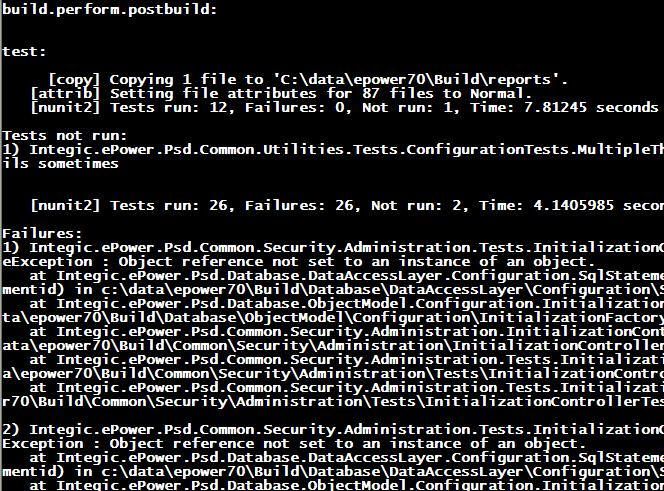
Until I get a build error, I don’t need to know or care about Joe’s test. But
when I do, I look at Joe’s unit test code and decide whether he was right. If
Joe’s unit test is valid, I need to either fix my breaking change or be prepared
to help everyone that uses my API to rewrite and redeploy their code. If Joe’s
unit test isn’t valid, I’ve got to help Joe fix his code and prepare to help
everyone else that made “invalid” use of my API to begin with. The very nicest
things about TDD is that “fixing breaking changes” becomes the least painful
thing to do!
This is huge. In fact, it’s so
huge, that MS should provide an end point for people to submit their own unit
tests against our Windows and .NET APIs so that when we make breaking changes,
we can either fix them or know the proportion of folks affected by this breaking
change.
Anyway, when Ward told me this, my eyes were opened
and I was changed. But he was just getting warmed up. After showing me the power
of formal unit tests across a team, he then went on to describe the power of
putting the unit tests right into specifications themselves. For example,
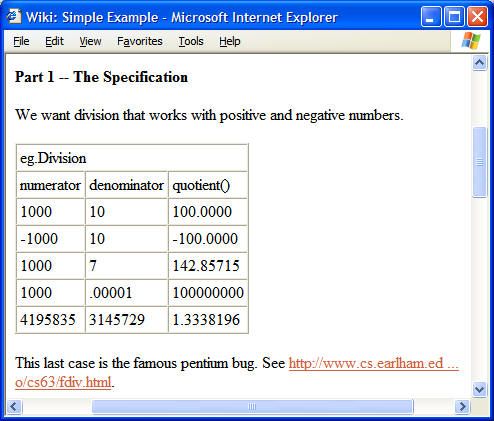
imagine a table in a spec laying out a series of inputs and expected outputs:
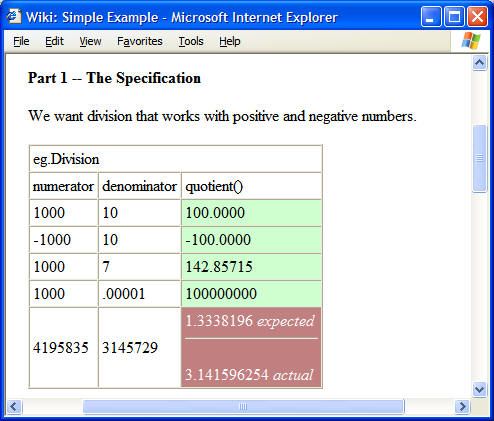
Now imagine a parser that could read through this table and execute the code
being specified, checking expected output against actual output, lighting
matching output green and mismatched output red:
This scheme lets designers define the spec long before it’s implemented and then
check it’s progress as it’s implemented. Likewise, a spec itself can be put into
the build process as another set of unit tests. Plus, the readability and
maintainability of specs in this format is much improved and very much more
accessible then unit test code.
But wait, there’s more. This
isn’t some pipe dream. Ward has a .NET implementation of it called
the FIT Framework on the web and yesterday he and I played around with it in
my kitchen. Our goal was to take Ward’s .NET FIT implementation and add support
to it for SOAP endpoints. We started with the
ISBN Information web service that we found on
xmethods.org and defined the following spec:
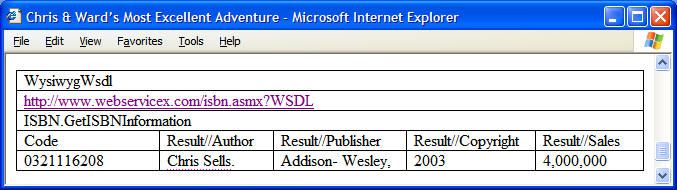
We specified the name of the FIT “fixture” (which is the class that implements
the tests in FIT), as well as the WSDL URL, the service type and method we’d
like to test, the arguments we’d like to test and the results we expected to
get. We mixed in some of
Christian Weyer’s Dynamic Web Services Proxy and we got this:
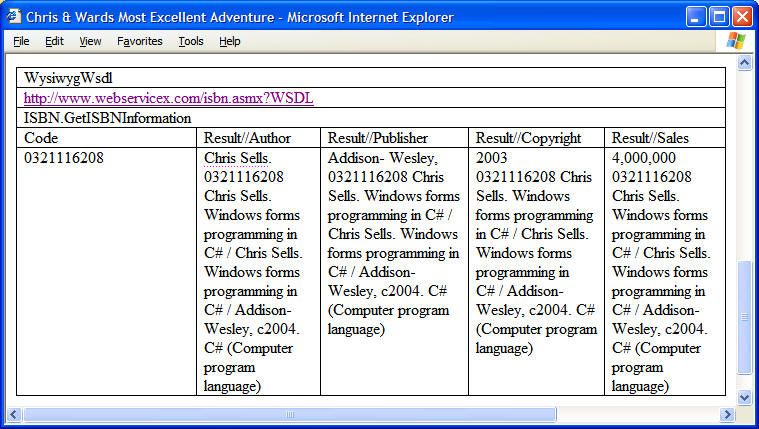
Notice that we’re not quite done yet, i.e. nothing is green and we’re not
reaching into the retrieved XML and pulling out the Author, Publisher, etc.
Still, while FIT requires a matching piece of code for every spec, we dropped a
bit more metadata into the tables for the SOAP version, leveraged WSDL and have
narrowed the project to a single piece of generic code for any WSDL-described
SOAP endpoint (so long as Christian’s code can parse it).
Our
plan is to finish up the extensions to FIT for SOAP and to put it into practice
on the SOAP API that I’m currently designing and even to push it into our build
process if I can. Further, I’d like to build another FIT fixture that, instead
of executing the tests, generates sample code to demonstrate example usage and
expected output (including expected errors). Rest assured, when we get it
working well enough for public consumption, Ward and I will publish the SOAP
extensions for your enjoyment.
But don’t wait for that! You
can do TDD with custom actions in VS.NET 2003 and with
the FIT Framework today!
Discuss