February 4, 2004 .net

Longhorn Migration & Interop: WinForms & Longhorn

February 3, 2004 .net

Preparing Today for Fewer LH Privileges Tomorrow

Karsten Jkdjflksjdf (or however you spell his last name : ) pointed out two excellent security articles today. The first is Developing Software in Visual Studio .NET with Non-Administrative Privileges.” Longhorn applications are going to run much better assuming fewer privileges, so getting yourself out of the habit of testing and running your own code as an Administrator is something you can do today to prepare for Longhorn tomorrow.

Another excellent article on this topic is from Keith Brown, a DevelopMentor colleague and security arch-Nemesis of mine (he never did like my plan of branding bad” applications by setting the first bit to 1 instead of 0… : ). Item #7 in Keith’s online book in progress, A .NET Developer’s Guide to Windows Security, is entitled How to develop code as a non-admin” and well worth the read for the practical advise as well as Keith’s pleasant writing style.

February 3, 2004 .net

“We’re full speed ahead on the R&D for speech”

Here.

Oliver Drobnik extracted a question out of a Q&A session with BillG asking about speech recognition in Longhorn. After BillG makes a very funny comment, he talks about the current state of speech recognition and synthesis today and a bit about the plan for Longhorn.

And Oliver? I’d rather not know what you’re planning on commanding your computer to do… : )

February 1, 2004 spout

On Behalf of Software Engineers, I’m Sorry

Here. The one where an hour of phone support with my step-mom causes me to feel embarrassed about what we put normal humans through to use our software.
February 1, 2004 spout

On Behalf of Software Engineers, I’m Sorry

Sunday, February 1st, 2004

I just got off the phone with my step-mother and boy are my arms tired. She way trying to do a mail merge. I told her about a month ago put data into an Excel spreadsheet in a data-like format (and I sent her an example spreadsheet to start from). Then, after entering the data into her spreadsheet, I recommended to her that she choose Mail Merge from the Tools menu in Word and she’d be home free.

Of course, she wasn’t. For example, after choosing her Excel spreadsheet, she was asked if she wanted to use first name, Sheet1$, Sheet2$ or Sheet3$ as her data. Having zero idea what SheetN$ was, she chose something vaguely human-sounding, which was exactly what she didn’t want, then was frustrated when her data didn’t come up. Later, after going away to buy hundreds of dollars worth of books (none of them telling her how to do Mail Merge using words that she could understand, btw), she opened up her document and was presented with a dialog box asking whether it was OK to run an SQL statement. What’s SQL?” she asked. Nothing that any normal human should ever have to see,” I replied, growing more embarrassed about the state of the output of my industry by the minute.

Later, when we got the data working with the merge (Remote Assistance, even over a slow phone line to Fargo, ND, works *very* well, once I figured out how to take control of her computer [answer: Take Control in the upper left]), she turned her attention to reformatting her letter. For example, she’d pasted some text from the web, which, by default, left this weird web formatting instead of making it look like the rest of her letter, so the styles were very different. Luckily, selecting the text and turning off the bold was enough, otherwise I’d have either had to reformat her entire letter or talk her through doing it. And how did I tell her to turn off the bold? By selecting the text and pressing Ctrl+B? Why did I tell her that? Because Word had taken the Bold toolbar icon off the toolbar and I couldn’t imagine describing to her what the little chevron was for so that she could get it back.

I’ve listed only a small percentage of issues I worked through with her, but lest you think otherwise, my step-mom is no idiot. She’s a nurse anesthetist, so has to keep tons of details in her head all day long or people die. Also, she’s trained her dogs to win first place obstacle courses in competitions around the country, one of whom was said to be untrainable. But when it came to Mail Merge, she worked for three weekends straight before giving up and calling me. It’s clear to me that for anything but the simplest of tasks that computers are not even close to ready for normal humans. On behalf of the software engineers everywhere, I’d like to apologize to Charlene (my step-mom) and the rest of the normal humans everything who are merely trying to make computers actually work. Hopefully Longhorn will fix this problem, but until then, I recommended that she return her computer to the manufacturer and get herself a Nintendo. After working through this with her for over an hour, I was only half kidding.

Discuss

January 31, 2004 spout

What Would You Save If Your House Was On Fire?

Here. The one where I spend a peaceful Saturday morning contemplating my life's possessions.
January 31, 2004 .net

MarkupCompilation: XAML, BAML, .g.cs Details

Rob Relyea, a Lead PM on the Avalon team, posts some history of XAML as well as a description of how it’s compiled into BAML and then into code. He also talks about CAML, which is used today in the PDC bits, but going away in the future.

I love these kinds of posts (and these kinds of articles) because they provide insight into what the designers of a particular technology had in mind, making it so much easier to learn. Having spent years of my life reverse-engineering the intentions of the COM designers out of the header files (because the docs and marketing materials actually pointed us in the wrong direction), it’s great when the folks behind the technology spill their guts. Thanks Chris and Jeff and Rob (and Mike and Don and the rest of the MS bloggers).

January 31, 2004 spout

What Would You Save If Your House Was On Fire?

What Would You Save If Your House Was On Fire?

Saturday, January 31, 2004

On a recent thread on my favorite mailing list ever, Jon Kale answers the question what would you save if your house was on fire,” which triggered my own thoughts along this line.

Assuming I’ve already made sure that the humans and the pets were out of the house, I’d make sure to grab my Omega X-33 (purchased during the bubble, of course), but since I go almost nowhere without it, it’s not likely to be burned up w/o its owner.

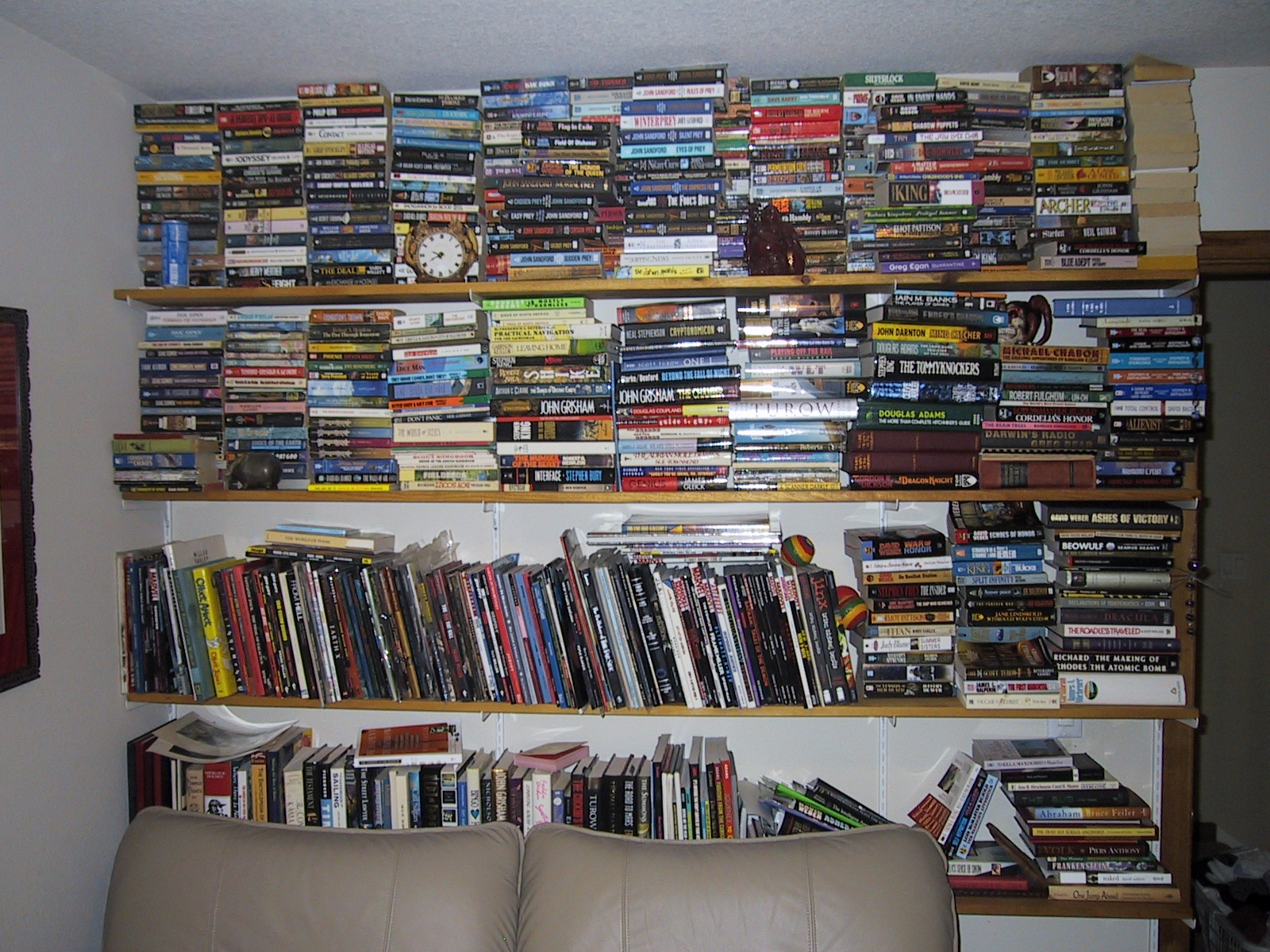
Also assuming I had a set of back-up CDs/DVDs for the last year in my safety deposit box (which I don’t have right now… please excuse the pause while I purchase a DVD burner… OK, $155 got me a top-reviewed DVD+R/DVD+RW drive with 30 blank DVD+RW disks delivered), the thing I would most miss is my book collection. The computer books could be replaced on demand, but my collection of just-for-fun books has literally taken a lifetime to collect and cull down to just things that I really love (click on the picture to get a closer look).

Often, when I want something comfortable to read, I’ll scan the shelves til something pops out at me and re-read it. Also, when friends & family come to town, I often take them to Powell’s City of Books and we play the Top 5 Books of All Time” game, purchasing what they point out for me and writing their name in the book so that when I read it, I can talk about it with the recommender (man, I’ve gotten some wacky books that way…). Losing those books, especially the ones I haven’t gotten to yet, would really hurt.

On the other hand, because you never know when you’re going to need to jam, my goal is to fit my entire set of positions on a memory hypercube (or whatever). But how do I back up the books when the atoms themselves are so satisfying? I mean, how can I recapture the feel of my leather-bound The Complete Frank Miller Batman, the back-pocket-worn The Silicon Mage, my copy of The Hobbit and The Lord of The Rings signed by my mother when I received my Master’s Degree because she read them to me when I was 10 or the ancient copy of The Complete Sherlock Holmes given to me by my father and to him by his father?

But even if I wanted a lossy digital backup of my books, how do I do it? I mean, I can scan all of my books and graphic novels, but only by destroying them. Why haven’t books, which are produced in digital form, made the transition to electronic availability? Are we waiting for the Tablet PC to get to a point of ubiquity?

So, in summary:

  • How do I back up my favorite atoms?
  • What would you save if your house was on fire (after humans and pets)?

Discuss


← Newer Entries Older Entries →