Here. From Hun Boon Teo: A research paper from two German scholars, part of the abstract: "Within this paper, we discuss the usage of aspectoriented programming techniques in context of the .NET framework. We focus on the fault-tolerance aspect and discuss the expression of non-functional component properties (aspects) as C# custom attributes. Our approach uses reflection to generate replicated objects based on settings of a special “fault-tolerance” attribute for C# components."
Here. "The idea of connectionstrings.com is to provide an easy reference for connectionstrings. All connection string and enumeration info are collected from other internet sites, books, helpfiles, Microsoft msdn, etc."
Holy cow! An entire site of just connection string examples! Cool!
[John Bristowe: radio.weblogs.com/0112381]
Here. I just like to read JasonW, but this one was particularly nice. He refutes some pretty wild claims from one member of the Java community.
Along these same lines, I spent a day of onsite consulting having a .NET vs. Java debate. I was the outsider .NET guy and the company already had three Java guys already on staff (one was the VP of Engineering). Needless to say, .NET won. : ) It boiled down to what to do with the existing ATL/COM/C++ code base and the .NET interop story wins there hands down.
Here. A somewhat wordy list of what's new in VS.NET 2003. It figures that just after I'd learned to use the Designer for event handling that MS would add C# "code spitting" for the override keyword and the delegate += operator...
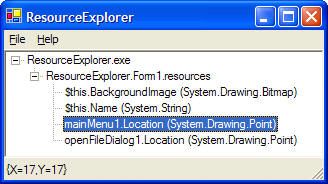
Here. In writing the resources chapter of my WinForms book, I found that there was no single utility for displaying the resource contents of assemblies, .resx files and .resource files (even embedded .resources files) in a way that made sense to me. So, I built one. Enjoy.
In writing the resources chapter of my WinForms book, I
found that there was no single utility for displaying the resource contents of
assemblies, .resx files and .resource files (even embedded .resources files)
in a way that made sense to me. So, I built
one and called it ResourceExplorer.
ResourceExplorer is very simple and could stand some
extension to show specific resources at images, text, data, etc, but it
certainly served my needs, especially when it came to understanding the
usage and limitations of the ResourceReader (for reading .resources files)
and the ResXResourceReader (for reading .resx files). Enjoy.
Here. From Husein Choroomi: "TeeGofer is a tool designed specifically for the .NET Component writer. Written in 100% native C# code, it works by reflection to read in metadata from .NET Assemblies (.DLLs or .EXEs) to create first class quality online help documentation. The Tool is extremely easy to work with, presenting a tree navigator of the entire structure of any Assemblies selected for the Help Project."
Really Cool!