Here. From Harry Pierson: Implemenation of an XmlReader-like class but for HTML. Most sites (like this one) that accept anonymous user input (like this entry) don't allow HTML tags because of the possiblity of scripting attacks. With the HtmlReader class, you could easily scan the HTML stream to ensure only specified and safe tags are used.
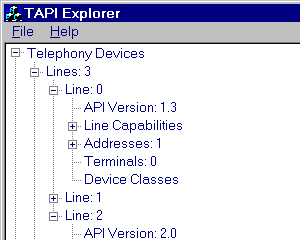
I built the TAPI Explorer (tExplorer) to allow me to
understand the various capabilities of the telephony devices installed on my
system when I was developing TAPI applications and writing my TAPI book. It
grew into a utility for showing all line, address and phone capabilities as
well as other TAPI settings, e.g. country codes, telephony locations,
service providers, etc. If you’re running into TAPI errors that you don’t
understand, TAPI Explorer will help you work through them.
This version has been run and tested on Windows 98, Windows
ME, Windows NT 4.0, Windows 2000 and Windows XP and supports TAPI versions
1.4 through 3.1.
Here. From Kim Gräsman: "As the Internet continues to evolve into an "Internet operating system"--programmable interfaces, ubiquitous access, and distributed computing resources--the document-centric browser is an awkward solution to a growing number of emerging needs. The browser is not dying by any means; it just needs a mate."
Here. "The philosophy of TMTOWTDI (There's more than one way to do it) is a direct result of observing that the Author of the universe is humble, and chooses to exercise control in subtle rather than in heavy-handed ways. The universe doesn't come with enforced style guidelines. Creative people will develop style on their own. Those are the sort of people that will make heaven a nice place."
This doesn't have anything to do with Windows programming directly, although I know a lot of Windows programmers use Perl, but I find Larry interesting and this in my news and so I'll post what I like. : )
This article is a Slashdot interview where dotters post questions and the interviewee answers them. In this interview, Larry compares Perl to Perl (5 vs. 6), Perl to Java, Perl to Python, Perl to .NET and, my favorite, Perl to the universe as a whole, where he sees himself as applying the same principles in the creation of Perl as God used in creating the universe (which explains why Perl is so messy : ).
[slashdot.org]
Here. From Jesse Ezell: What happens when you mix Prevalence with ContextBoundObjects? Something like this...
I followed the link over to the FAQ on Prevalence and it was interesting enough for me to take a closer look at. However, what really turned me off though was that you had to create all this ICommand and IQuery junk to make it work, so you really weren't working with the same objects anymore (kind of defeats the purpose if you ask me).
So, I took a few spare hours after work and hacked a "TransparentPrevalence" framework that extends the concept using MessageSinks, ContextBoundObjects, etc. to provide automatic support for persistant objects without all the clumsy command and query objects. It is just a proof of concept, but if someone wants to build on it, feel free to download the source and let me know what you come up with.
Too bad I had to work last Friday, this would have been a great "Spend a Day With .Net" project.
Here. "[O]ne thing doesn't make users happy—not having full control of any processing that their applications are performing. Even though the UI is responsive while pi is being calculated, the user would still like the option to cancel the calculation if they've decided they need 1,000,001 digits and they mistakenly asked for only 1,000,000."
In this article, I add canceling to my asynchronous pi calculating WinForms app.
Here. I believe that this 1968 article by the recently deceased Edsger Dijkstra, the inventor of the modern operating system and the stack model of computing, is the very first "considered harmful" article from which all others were inspired.